 | From NRCan Resource Wiki |
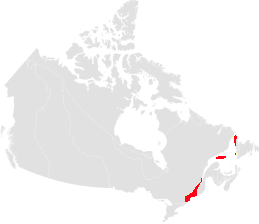
The climate ranges from continental (west of Quebec City) to maritime. The north eastern part of the region is notably cooler due to effects of the Labrador Current. Within the region mean annual temperatures range from 2.5C to 5C. Mean annual precipitation ranges between 800 and 1100 mm per year. Spring arrives in the west in April, and snow may linger in the east into May. Mixed wood forests of sugar maple, yellow birch, eastern hemlock, and eastern white pine form the most stable vegetation in the western part of the region but have been severely reduced in extent by extensive agriculture. The eastern area has boreal forest cover and in Newfoundland extensive wetlands covers more than 25% of the area.
The region includes the central and eastern St Lawrence Lowland areas. The area is relatively flat lying and rarely rises above 150 m elevation, except for the Monteregian Hills in the Montreal region. Relief is flat to rolling with abrupt changes in relief along the margins of the area. The hydrological system is dominated by the Ottawa and St Lawrence rivers. The low relief physiography mimics the relatively horizontal attitude of the sedimentary strata the Appalachian basin. It consists of limestones and clastic rocks that are up to 2300 m thick and were deposited along the passive continental margin prior to the Appalachian Orogeny. Extensive normal faulting offsets bedrock units by tens of metres and there is gentle broad amplitude folding of some formations. Karst is developed in the carbonate rocks, most notably along major rivers or escarpments. There is natural gas production from dolomitic rocks of southern Quebec. The area from the Saguenay Fjord to Quebec City is a seismically active region. Surficial sediment covers most of the area and is generally < 20-30m thick, with maximum thickness infilling buried bedrock valleys of 150m. An idealized stratigraphic succession from bedrock is sand and gravel, till, glacifluvial sand and gravel, marine mud, and littoral or alluvial sand and gravel. The thickest and coarsest glacifluvial deposits infill buried valleys or form eskers.
 Groundwater Information Network